International dance day. Kalash celebrates the
day
By Zahiruddin
CHITRAL: On the occasion of international dance day, the
people of Chitral lamented the fading away of dance from their
culture with the advent of new age while Chitral had a rich
diversity of dancing which had 360 types in practice in the recent
past.
The dancing art of Kalash, the primitive people having unique ways
of living in Southern Chitral, however, is in robust form due to
the fact that dancing was the not only the part and parcel of their
culture but formed their basic religious ritual.
The former project manager of IUCN project in Chitral, Dr.
Inayatullah Faizi said that the people of Chitral can be divided
into two with respect to their culture and traditions which
included Khow and Kalas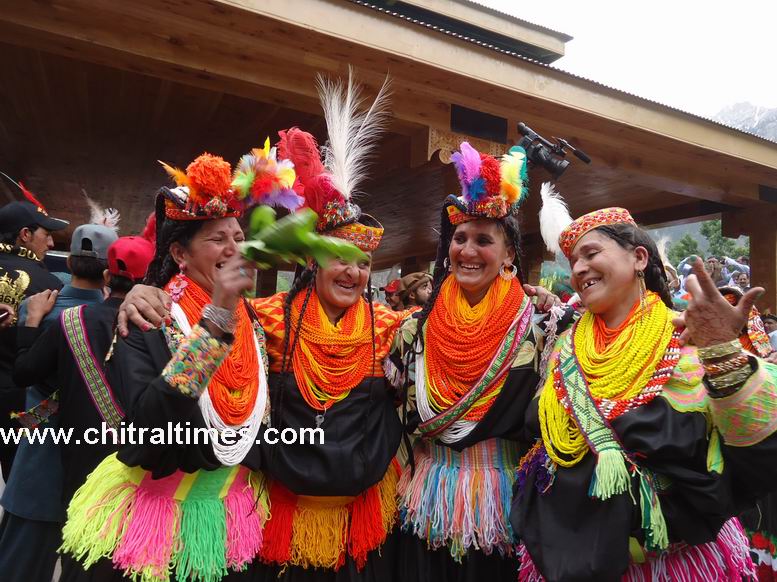 h
and there was a great diversity in Khow culure as they lived in 33
different valleys. h
and there was a great diversity in Khow culure as they lived in 33
different valleys.
He said that in the present time, the Khow people have consigned to
oblivion a large chunk of their immaterial culture in the form of
dancing as they have almost forgotten as many 288 types of dance
out of 360.
�In the present age, a younger person can hardly name any four or
five types of Chitrali dance while he will not be able to give
their description�, he said adding that the declination of the
dancing culture was going unnoticed and it may completely
annihilate in the coming two decades or so.
He said that Chitral Scouts had salvaged a part of Chitrali music
and dancing by the inclusion of a band of musician in the force and
it was in 1982 when the then commandant of the force, colonel Murad
Khan Nayyar discovered an ageing person from a distant valley of
Chitral named Woor Muhammad, who was called to the garrison of
Drosh to teach the art of khongora phonik (dancing with swords) to
its jawans.
He said that a few number of other famous types of dancing were
preserved by the National Institute of Folk Heritage in late 1970s
as its team visited the far-flung areas of the district to record
thedances being performed by the elder people.
The president of Anjuman Taraqqi Khowar Chitral, Shahzada Tanvirul
Mulk was of the view that presently, Shishtuwar, Nohtik, phastok,
barwazi, Shabdaraz and tatari wawari were some of the types which
were still population among the younger generation.
He said that there are a number of valleys in Chitral including
Lotkoh, Laspur, Yarkhoon and Biyar where dancing culture is still
in rich form but the traits of old culture are being replaced by
that of alien ones.
Kalash may be the only religion in the world in which dancing is
one of the obligations of its followers and a child of five years
starts to learn different feats of dance as part of his or her
faith and it is abundantly interesting to note that the Kalash
people dance for three days and nights around the dead body before
its burial.
Luke Rahmat, an educated youth from Bumburate valley, said that
dancing culture of Kalash has no perils to threaten it as they
danced as part of their religion and it formed a major component of
all their festivals.
He said that in any festival of Kalash, one will find a lad or lass
of 7 years and an old man of about 90 years dancing in the same
group and it is here the traits are transposed to the new
generation from the old.
Regarding the types of Kalash dances, he said that they were few in
number and associated with certain festivals and occasions and each
type were essentially different from the other and all they were
exhibited on the occasion of chilim jusht which was their major
festival held in the spring season.
|

 :: Front
Page
:: Front
Page


