|
Prince Burhanuddin of Chitral
(A World War II Veteran)
Chitral is known for its difficult terrain and harsh
climate conditions. It is situated on the most north west of KPK,
Pakistan. Lowari pass is the only way which links Chitral with the
rest of the country. Before the making of tunnel under the lowari
mountains Chitral remained cut off from the rest of the country for
six whole months due to heavy snow fall on the top of the lowari
pass. These difficult conditions would dreadfully affect the people
of Chitral. But nature has bestowed Chitralis with such an energy
and adventurism that they are never reluctant to face these
conditions. Out of such miser conditions they have this tremendous
quality to produce something very outstanding and heroic.This
article is one of the tales about those Chitralis who fought with
these conditions and at the same time rose to become very
well-known heroes.
The
hero, whom this article has been written on, was Prince Burhanuddin.
He was son of Mehtar Shujaul-Mulk.He
was born in 1915 in Dolumus valley, Chitral. Later he would go on
tobecome commander of the then outlawed Indian National Army in
Burma fighting British colonial rule during World War II.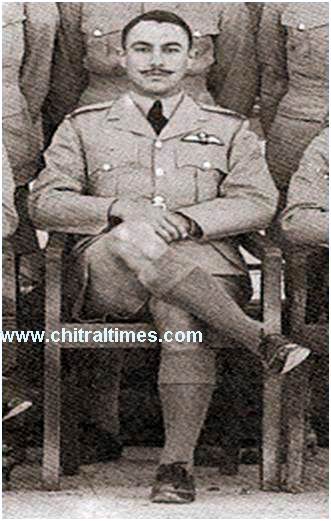
Islamia College Peshawar remained his Alma Mater along with Prince
of Wales Royal Indian Military CollegeDehradun, where he graduated.
In 1935 he was commissioned in British Indian Army as second
lieutenant. As was the case those days that competent officers from
infantry would be taken in air force. Prince was also taken in
Royal Indian Air force as pilot.
He joined the IAF 1stSquadron sometime in 1939 and
remained with them till at least January 1941.
The first assignment, that Burhan was with the Squadron, was to
form part of the "Q" Flight - which was sent to Karachi for Coastal
Defense Duties.The
British Indian Air Force was established in 1932 and not
surprisingly the initial pilots were called �Hawaii Sepoys� to
reflect their origins as army sepoys.During his air force carrier
exploits of Burhan were remarkable.
Burhan went back to his Baluch Regiment Infantry duties sometime in
1941 and was sent to Burma to fight against Japan. Actually most of
the soldiers of Indian Army of those days did not want to fight
World War II. They thought it was not India�s war but they were
forced to go to that war. Burhan and some of his friends put a
condition in front of viceroy of India that if Britain would leave
their land after they win WWII for them then they are ready to
fight. This condition was unacceptable for Viceroy so they parted
their ways from army and handed over themselves to Japanese Army.
Japanese Army offered two options for them. Either they would live
as prisoners and build bridge at river Kawai or fight back British
troops from their side. The second offer was what they were dying
for. They readily agreed to fight Allies with Japanese Army.
Freedom movements had started in India against the British rule as
early as twentieth century, but growing sense of nationalism and
awareness came slowly to the people of modern day Pakistan due to
isolation. During World War II most Indian people were aware of the
fact that Britain was exploiting them and they were able to feel
the need for resistance against British rule. Indian National Army
(INA) was also made on the base of this realization. The INA
was an armed force formed by Indian nationalists in 1942 in Southeast
Asia during World
War II.
The aim of the army was to secure Indian
independence from British
rule, for which it allied
with and was supported by Imperial
Japan in
the latter's campaign
in South-East Asia.
Burhan and some half million other soldiers joined INA under the
command of Subhas Chandra Bose. Conditions were conducive for the
Axis� victory until when USA dropped Atom Bomb on Japan. This
attack broke the backbone of Axis and very soon Japan surrendered
to Allied powers. Burhan with his men was captured by British
troops and they underwent court Martial. Court sentenced him and
his men to death. They were kept in prison in Red Fort Lahore.
Their case was appealed in High Court, and people of the city
strongly demonstrated their death sentence. These chaotic
conditions impelled the government to move them to another prison
in Haripur.
In
the mid nineteen forties freedom movements had engulfed the
imperial rule in India. On 3rdjune 1947Lord Mountbatten
announced plan of Partition for India. This divided India into two
states and the formal independence of Pakistan was going to be
declared on 14 August 1947. This incident pawed the way of release
for the prisoners. Burhan with his men was released on 13th
August 1947 and their death sentences were nullified. After his
release he immediately came to Chitral.
Chitral, after independence had declared to Accede to Pakistan but
formal declaration was yet to be announced and it was Independent
state yet. MuzzafarulMulk was Mehtar (ruler) of Chitral that time.
Burhanuudin wanted to come back and join the newly formed Pakistan
Army but Mehtar wanted him to command the Chitral Body Guard Force
(CBGF) as the former knew he was a competent officer. So he could
not refuse to Mehtar�s request and became Commander In Chief of
CBWF. He organized the force very well and made it familiar with
the modern tactics of War. He imported modern weaponry and armed
the force very well.
After division of India, Kashmir was an unresolved territory.
Maharaja of Kashmir did not want to accede to Pakistan. Burhanuddin
wrote him letter threatening him of Jihad against his forces if he
did not accede to Pakistan. Maharaja was in no way ready to accede
to Pakistan so Burhanuddin waged Jihad against him along with other
tribes of North Western Areas of Pakistan. The State Body Guard
Force fought under him very well. They captured Skardu and went on
to capture areasall the way toChilas. From there on they advanced
to the rest of Kashmir. They were moving on capturing village by
village when suddenly they were told to halt their advancement amid
the extreme pressure put by UN upon Pakistan. Even though they had
released a lot of Kashmir territory from Maharaja and Indian
occupation.
He
remained commander of the Body Guard Force until its transformation
into Chitral Police Force in 1953. Then in Ayub�s era he contested
election under Basic Democracies and elected Chairman of his sub
division Chitral. In 1990s he was elected as senate member of the
parliament. In 1995 after short illness he died and was buried in
his hometown.
The
words "Colourful" "Infamous" etc. are used in context with
Burhanuddin's name are because he was an interesting figure. Quite
a few used to look at him like an eccentric character. Air vice
Marshal Harjinder Singh has quite a few tales to tell of Burhan -
one of which involved Burhanuddin requesting Harjinder to teach him
how to drive a car. As Harjinder recalls - Burhan-ud-din was an
absolutely hopeless case as far as learning to drive a car was
concerned. Flying an aircraft was much simpler for him - with the
simple throttle and all. But to drive a manual transmission car
which requires solemn control over the Clutch, Burhan proved
absolutely beyond help and in fact ended up wrecking his car by
reversing into a wall. That was the first time he discovered that
his car had a reverse gear!
There are some more funny and strange things about Burhan. One of
his unit officers tells some of it. He says that�there were some
people who never should have joined any air-force. As the
detachment commander at Miranshah, I had the misfortune to have a
new posting. I will call him Burhan. Son of a petty chieftain from
way up north, he first joined the army but one mess night he
threatened to shoot his C.O. after the latter had remonstrated that
Burhan�s two dogs would not let him enter the building. Burhan
promptly retorted, �Sir, you shoot my dogs and I will shoot you.�
Well, that is how I had him in my unit�.
He
was a very simple and strictly Islamic person and he really had
love for his Muslim brothers. This love can be perceived from his
secret services which he performed to save lives of his Muslim
Brothers in the tribal region of Afghanistan during the final
Afghan War. The pilots were told to target the resistive population
of Afghanistan who had taken up arms against the British
aggression. Before going on to accomplish his missions he would use
to send messages to the people of areas, to be targeted, to vacate
them before bombardment.
In
the end what I conceive from his services for Muslims and the
Independence of India is that he really deserves the title of
Hero.
Elahi
Bakhsh Chitral
 |

 :: Front
Page
:: Front
Page


